Sunday, 10 November 2013

What's in the Forest?


kiwkiwi
filmy fern / irirangi
mangemange


              Ferns found in the forest

kidney fern
rosella

Tyler with a magpie caught on the Mad Woman's track.
Miro / Tomtits

Riroriro / Grey warbler
Native orchids

Puketea flowers

Green stick insect

Life in the Forest. Busy October!

 Life in the Forest. Busy October! 

Planting day on Limestone/Matekohe Island
Rare Hibiscus richardsonii planted on a bank beside the path on Matekohe Island.

 This is Kipp. He was a Teacher Fellow too.  One of his projects was to propogate the seeds from Hibiscus richardsonii.  They only grow in three places in the whole world.  All of them are in Northland. Now they are on Limestone Island and you can see them growing there.

                                                                 Counting Weta


Counting weta in the boxes in the forest and on Limestone Matekohe  Island.

In the Forest


 Cutting tracks for bait stations to stop those pesky possums eating all the trees, insects, chicks and birds eggs.


hammering up 102 Gecko covers.


Cutting the rubber covers and


Wednesday, 2 October 2013

What plant is that?


What plant is that?
What plant is that?
Last week I went to Warkworth to a course to learn the names of plants.  It was really interesting.  I don't know all the names yet but now I know how I can find out. We had to learn how to describe them with the right words and how to take a sample without hurting the plant.  
Which plant do you think this is? 
It is a small plant with small leaves, from 3 - 6 cm long.
The leaves are bright green.  They have 3 lobes and are palmate in shape. The stems are covered in fine hairs.  The leaves are green underneath and have veins running from the stem to the tip.   This plant is endangered and only grows in 3 places in the wild. 

                                                                                                                    Today we planted 80 Hibiscus richardsonii on Limestone/ Matekohe Island.  I hope they will all grow.  This man is Kipp.  He teaches at Whangarei Boys High School.  He was a Teacher Fellow too.  He grew hundreds of these plants from seeds.

                                                                                                                   
Phillip Kippenburger
On Monday and Tuesday I went deep into the forest to help cut tracks so that poison can be laid in traps to kill the possums and rats.  Can you see what we caught?  We have to kill the pests or they will eat all the trees, the bird's eggs and chicks and even all the food that the birds need to survive.  When they are gone, little birds like this riroriro can live safely in the forest.  If we get rid of the predators then maybe we can bring back the kiwi and the kōkako to live in the forest too.
 
Riroriro


 I have been nailing gecko covers on to the trees.  I am hoping that the lizards will come and live under the covers where they are safe from rats.  Next year we will come back and look underneath to see how many we can find.  If we find lots of weta and geckos it means that we have killed most of the predators (because they weren't there to eat the weta and gecko). It also means that the forest is healthy again.


This is Ben and Dylan. 
They are herpetologists.  
Herpetologists study everything about lizards.  They have came to teach me how to put up the gecko covers and where to look for geckos.  So far I have only seen one live copper skink and one dead one.


Copper Skink


Sunday, 22 September 2013

Auckland Visit

Hauraki Gulf Forum

I was lucky as I was able to go to a seminar at Auckland Museum.  There were lots of important scientists and environmental experts at the seminar.  They were talking about all the things that people are doing to try and keep the Hauraki Marine Reserve a safe place for whales, dolphins and sea birds as well as people.  They talked about the plans they had for the future too and how they wanted to make a Marine Spatial Plan so that the harbour could be used by everyone but without damaging the environment.  There is a fantastic exhibition on called Moana - My Sea that shows what is under the ocean.

Three important scientists won awards for the work that they are doing to help the whales and birds in the Hauraki Gulf:

Dr  Rochelle Constantine for helping to save the Brydes whale.

Keith Woodley for working with godwits at the Miranda Shorebird Centre

Chris Gaskin for his work with the rediscovery of the NZ storm petrel 

http://www.aucklandmuseum.com/

Dame Anne Salmond is the New Zealander of the Year.  She talked about a project called Te Awaroa - 1000 rivers.  Her plan is to restore the health of a 1000 rivers in New Zealand.  It will be a joint project working with lots of groups including Enviroschools  - so that means us.

Kamo Primary has already started.  When we monitor the water in the Otapapa Stream and plant trees along the stream banks to keep the water clean and cool, we are helping to restore our water ways. 


 Ark in the Park  ‎www.arkinthepark.org.nz‎

In the Waitakere Ranges  in Auckland there is a special park called Ark in the Park. The Ark in the Park is a Forest and Bird restoration project in the Cascade Kauri Park, northern Waitakere Ranges, Auckland.   Why do you think they called it that?

It is a special forest where they have been trapping for pests for a long time and now they can reintroduce birds that had diappeared from the park.  This is where they brought kōkako back into the forest.  It is a beautiful forest full of giant Kauri trees.  Do you know another forest where you can see a lot of giant kauri?

I talked to the staff and learnt all about their trapping program and how they look after the park.  This is what we want to do in Pukenui Forest. If we can get rid of enough of the pests then we can bring back some of the birds that have gone like the kōkako and the kiwi.


The most important thing that I have learnt so far is that conservation is all about getting rid of the pests that are destroying the forest and eating the birds eggs and killing the young birds.  There are lots of them. That's why we have to put traps and poison in to the forest. How many can you name ?

rats       possums      stoats        ferrets        cats       dogs      pigs      goats     

Somethings eat the same food as the native birds and insects and then there is not enough food for the native animals to survive.

mice       hedgehogs      rabbits   

Some bugs are so small we can't see them like the Kauri die-back disease.  We don't want to lose all the beautiful Kauri trees so we have to be careful that we don't spread the disease from place to place on our shoes. These are brushes to clean the mud off your shoes and spray guns to spray them with disinfectant.


                                Kaipatiki Project  

http://www.kaipatiki.org.nz/   

The Kaipatiki Project is a project set up by the community.  A group of volunteers wanted to look after the water ways so they started clearing weeds and planting native plants to keep the streams clean and cool.
Lots of people came to help and soon they had a whole organisation with a nursery full of native plants ready to be planted.
I spent a morning helping to count the trays of plants in the greenhouse and learning about eco-sourcing seeds from places near where they will be planted.
I watched other people potting on the seedlings into bigger pots ready to be put outside.

 
I asked lots of questions and tried to learn as much as I could but I think I will have to go back and volunteer again so that I can learn more.


Kowhai


Here are some of the plant names I tried to learn.


 Graduation

September 24th
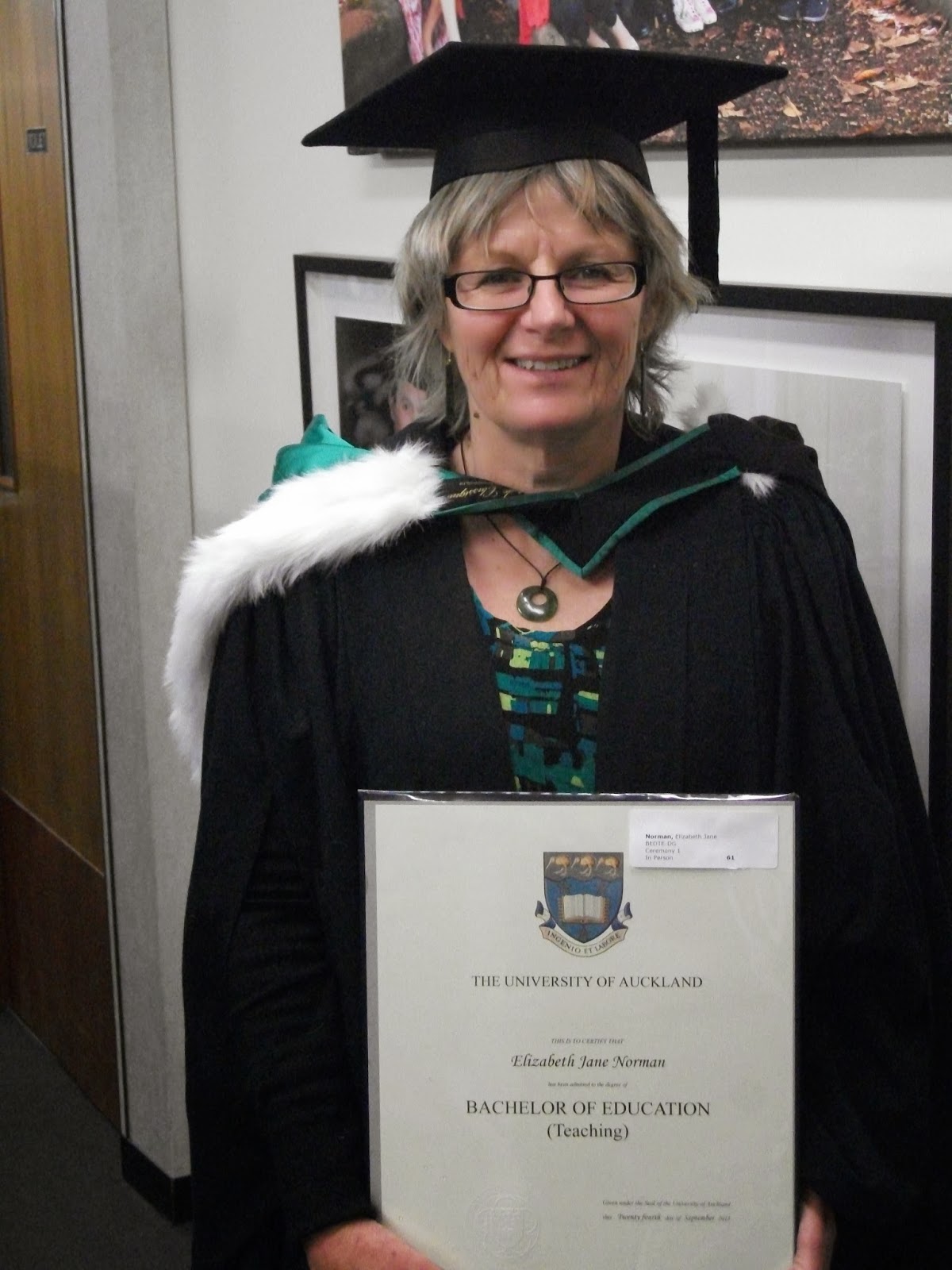
Today I walked across the stage with hundreds of other people at the Aotea Centre to receive my Bachelor of Education from the University of Auckland.  Do you like my hat and cloak?  It's called a 'mortar board' and 'gown'. It belongs to a very old tradition that shows that you have worked hard at university to get a degree. One day you might go to university and walk across the stage to get a degree too.

Thursday, 12 September 2013

LImestone/Matekohe Island

I spent a day helping out on Limestone/Matekohe Island.  I was helping to build a new track with steps so that people can walk more easily around the island.  I also went to look behind the gecko covers to see if I could find any geckos.  No geckos but hundreds of weta!


                                                                                        This is what I wanted to find.


This is what I found,
only hundreds of them!

Wednesday, 26 June 2013

Tēna koutou.  Tēna koutou. Tēna koutou katoa.
Ko Jane Norman tōku ingoa.
Ko kaiako ahau.
Ko Kamo Tuatahi tōku kura.
No Whangarei ahau.

Hi everyone. You might see me around school sometimes in the next two terms but I will just be visiting.  For Term 3 and 4 I am going to be learning all I can about Science.  I will be called a Primary Science Teacher Fellow.  If you want to see what I am doing just click on the tab that says 'Mrs Norman.' Don't forget to write on your blog too so I can see what you are all doing.


Monday, 24 June 2013


Zac's got the ball.  Watch out for that fend!

Izzy's got the ball.  Go Izzy!
Saturday Rugby.   GO the Kamo Kids!  June 2013